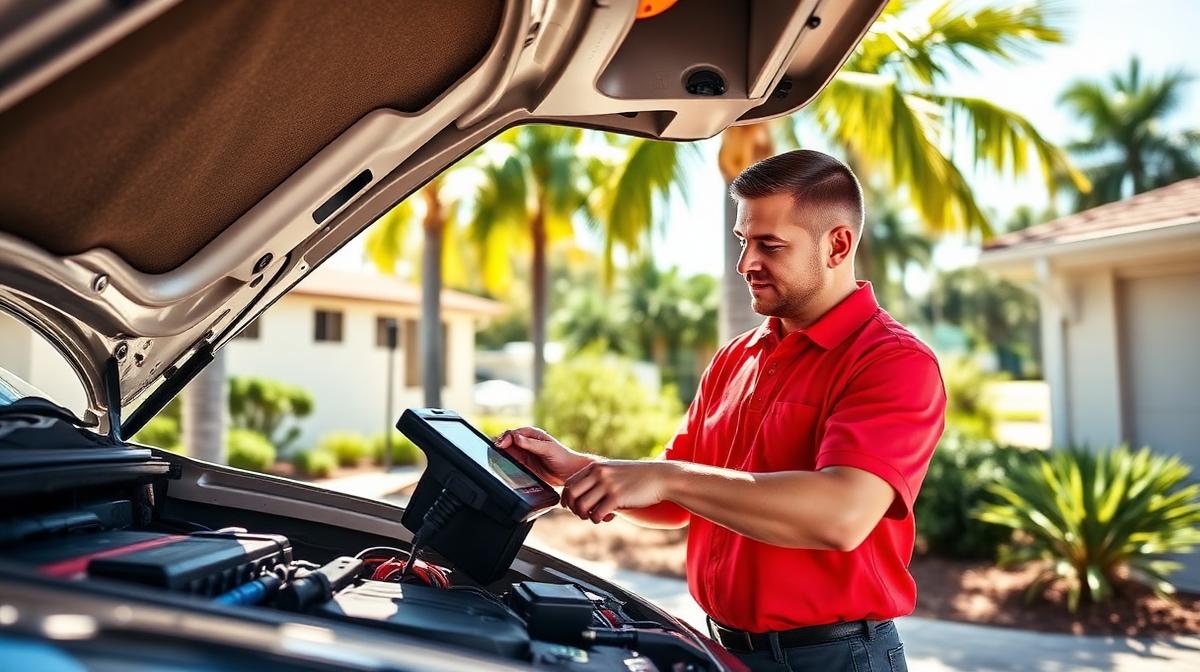
You're running late. You grab your keys, jump in the car, turn the ignition—and nothing. Maybe a click. Maybe silence. Maybe the engine cranks endlessly but refuses to fire. In Southwest Florida, this scenario is far more common than most drivers realize, and the heat is almost always a factor.
After 32 years of turning wrenches—and the last decade providing mobile auto repair across Fort Myers, Cape Coral, and the surrounding areas—I've diagnosed thousands of no-start conditions. Florida's extreme heat doesn't just make you uncomfortable; it actively destroys the components your car needs to start. I'm going to walk you through exactly what happens under the hood when temperatures climb, and what you can do about it.
Stranded right now?
If your car won't start and you need help now, don't wait—call us for same-day mobile no-start diagnosis right at your location.
Call (239) 483-0506How Florida Heat Destroys Your Car's Starting System
Most people think of winter as "dead battery season." In northern states, that's true. But here in Fort Myers and Cape Coral, summer is when we see the most no-start calls—and it's not even close.
Here's what sustained 90°F+ heat does to your vehicle:
Accelerated Battery Degradation
Heat causes battery fluid to evaporate, corrodes internal plates, and increases self-discharge rates. A battery rated for 5 years up north may last only 2-3 years in Florida. I've covered this extensively in my complete battery replacement guide.
Starter Motor Burnout
The starter motor generates enormous heat during cranking. In an already-hot engine bay, this heat has nowhere to go. Repeated short trips with the engine barely cooling between starts accelerate starter failure.
Fuel System Vapor Lock
Extreme under-hood temperatures can cause fuel to vaporize in the lines before reaching the engine—a condition called vapor lock. The engine cranks but starves for fuel. Modern fuel-injected vehicles are more resistant but not immune, especially with aging fuel pumps.
Sensor & Electronics Failure
Crankshaft position sensors, camshaft sensors, and engine control modules are heat-sensitive. A sensor that works fine at 80°F may fail intermittently at 130°F—the typical under-hood temperature on a Florida summer day. This is where professional engine diagnostics become essential.
Wiring & Connection Corrosion
Florida's combination of heat, humidity, and salt air creates the perfect storm for electrical corrosion. Battery terminals, ground straps, and starter connections develop resistance that prevents adequate current flow.
The 3 Types of No-Start Conditions (And What They Mean)
When I arrive at a customer's location in Estero, Bonita Springs, or anywhere in Lee County, the first thing I do is listen. The sounds your car makes—or doesn't make—tell me a lot before I even pop the hood.
1. No Crank, No Start (Complete Silence)
You turn the key and get absolutely nothing. No cranking sound, no clicking, possibly no dashboard lights. This is the most common no-start complaint I see during Florida summers, and 70% of the time it traces back to the battery or its connections.
Common causes in Florida heat:
- Dead or severely discharged battery (heat-accelerated failure)
- Corroded or loose battery terminals—Florida's humidity makes this especially common
- Failed starter solenoid or relay
- Faulty ignition switch (heat can cause internal contacts to expand and lose connection)
- Security system malfunction (heat-related electronics glitch)
- Bad ground connection
2. Clicks But Won't Crank
You hear a rapid clicking or a single loud "clunk" when turning the key. This is your starter trying to engage but lacking the electrical power to turn the engine over.
What this usually means:
- Weak battery—still has enough charge for lights and electronics, but not enough amperage to crank. This is extremely common with batteries over 2 years old in Florida
- Corroded battery cables adding resistance
- Worn starter motor drawing excessive current
- Poor ground connection between engine and chassis
3. Cranks But Won't Start
The engine turns over normally—you can hear it spinning—but it refuses to fire and run. This is typically the most complex no-start condition because it involves fuel, spark, or timing rather than the electrical starting circuit.
Florida-specific causes:
- Failed fuel pump (heat-soaked fuel pumps are the #1 cause I see in summer)
- Vapor lock in fuel lines
- Heat-damaged crankshaft or camshaft position sensor
- Flooded engine from excessive cranking attempts
- Failed ignition coil(s)—heat accelerates coil pack degradation
- Anti-theft system lockout
What I Check During a Mobile No-Start Diagnosis
When you call Dash Auto Services & Mobile Repair for a no-start, I come to your location—your driveway in North Fort Myers, your office parking lot in Gateway, or wherever your car is sitting. Here's my systematic approach:
Step 1: Listen & Observe
I listen to what happens when you attempt to start the vehicle. The sound (or lack of sound) immediately narrows the diagnosis by 60-70%. I also check dashboard warning lights, which provide critical clues about which system has failed.
Step 2: Battery & Electrical Testing
Using professional-grade equipment, I test battery voltage, cold cranking amps (CCA), and the condition of terminals and cables. A battery might show 12.4V (seemingly healthy) but fail under load—a common Florida scenario where heat has damaged the internal plates.
Step 3: Starter Circuit Testing
I test voltage drop across the starter circuit, check the solenoid, and verify the starter is receiving proper signal and power. A voltage drop test under cranking conditions reveals hidden problems that simple voltage readings miss.
Step 4: Fuel System Verification
If the engine cranks, I check fuel pressure, listen for the fuel pump priming, and verify the fuel injectors are receiving pulse signals. Heat-soaked fuel pumps are one of the trickiest diagnoses because they can work fine once the car cools down.
Step 5: OBD-II Scan & Sensor Analysis
My professional scan tool reads stored and pending trouble codes, live sensor data, and freeze frame information. This reveals intermittent sensor failures that only occur at high temperatures—the kind of problem that comes and goes with the Florida heat.
The #1 No-Start Cause in Florida (It's Not What You Think)
Most people assume a dead battery means a bad battery. But in my experience working across San Carlos Park, Fort Myers Beach, and Pine Island, the root cause is often a failing alternator that killed an otherwise good battery.
Here's what happens: Florida heat degrades the alternator's internal diodes and voltage regulator. The alternator starts undercharging the battery—maybe putting out 13.2V instead of the proper 14.2-14.7V. Over weeks, the battery slowly drains down. You replace the battery, and it works great—for a few months. Then it dies again. I see customers who've replaced 2-3 batteries before someone finally tests the alternator.
That's why every no-start diagnosis I perform includes a complete charging system test. Replacing a battery without testing the alternator is throwing money away—and I refuse to let my customers do that. It's part of my philosophy: Fixed Right The First Time.
Warning Signs Your Car Is About to Leave You Stranded
Most no-start conditions don't happen without warning. Here are the signs I tell my customers to watch for, especially during Florida's hottest months (May through October):
- Slow cranking: If the engine turns over more slowly than usual, your battery or starter is on borrowed time. Don't ignore this—especially in summer.
- Intermittent starting problems: The car starts fine in the morning but struggles in the afternoon heat. This is a classic sign of a heat-sensitive component (often a crankshaft position sensor or starter).
- Dimming headlights at idle: This usually indicates an alternator that's not keeping up with electrical demand—a precursor to battery failure.
- Dashboard warning lights: A battery light, check engine light, or security light that comes on intermittently is your car asking for help.
- Clicking sounds when starting: Even if the car eventually starts after a click or two, this means your battery is marginal. In Florida heat, "marginal" becomes "dead" very quickly.
- Electrical gremlins: Power windows moving slowly, the radio resetting, or the clock losing time—these can all indicate a charging system problem.
If you notice any of these symptoms, a proactive diagnostic check is far cheaper than a tow truck and emergency repair. I offer a comprehensive tune-up service that catches these issues before they strand you.
Don't Get Stranded in the Florida Heat
Whether your car won't start right now or you're noticing warning signs, I come to you—anywhere in Lee County. Same-day service available.
Why Mobile No-Start Diagnosis Makes More Sense Than a Tow
When your car won't start, the traditional approach is to call a tow truck, wait an hour (or more), pay $100-200 for the tow, then wait again at a shop for diagnosis. In Florida's heat, that's miserable—and expensive.
With mobile auto repair, I bring the shop to you. About 60% of no-start conditions I diagnose can be repaired on-site the same day—battery replacements, starter swaps, sensor replacements, and electrical repairs. For the remaining 40% that require shop-level work, at least you have a clear diagnosis and cost estimate before deciding on a tow.
If you've already had your vehicle diagnosed elsewhere and know exactly what's needed, I even offer a diagnostic fee waiver—you only pay for the repair. That's something you won't find at most shops. Learn more about our transparent pricing.
Preventing No-Start Problems in Florida: A Maintenance Checklist
Prevention is always cheaper than repair. Here's what I recommend for every vehicle owner in Southwest Florida:
Annual Heat-Season Checklist:
- ✓Battery test every 6 months after the 2-year mark. Don't wait for symptoms—batteries in Florida fail suddenly.
- ✓Clean battery terminals annually. Use a wire brush and apply dielectric grease to fight Florida's corrosive humidity.
- ✓Check alternator output. A quick charging system test reveals problems before they kill your battery.
- ✓Inspect belts and wiring. Heat and UV degrade rubber and insulation. Cracked belts and brittle wiring cause no-starts.
- ✓Keep fuel above quarter tank. Running low increases fuel pump temperature and accelerates pump wear.
- ✓Park in shade when possible. Reducing under-hood temperatures extends the life of every electrical component.
Need help with any of these? My mobile oil change service includes a complimentary multi-point inspection that covers battery health, belt condition, and fluid levels. Consider it your vehicle's heat-season checkup.
When to Call a Mobile Mechanic vs. When to Call a Tow Truck
I'm upfront with my customers—there are situations where a tow to a full shop is the right call:
📱 Call a Mobile Mechanic When:
- • Car won't start (battery, starter, alternator)
- • Clicking or no-crank conditions
- • Check engine light with no-start
- • Intermittent starting issues
- • Electrical problems preventing start
- • Sensor-related no-starts
🚛 Call a Tow Truck When:
- • Engine overheated and seized
- • Timing belt/chain snapped
- • Transmission won't engage any gear
- • Major collision damage
- • Vehicle is in an unsafe location
- • Suspected internal engine damage
Not sure which situation you're in? That's exactly why I offer a thorough inspection service. Or just give me a call—I'll help you figure out the best next step over the phone before you spend a dime.
The Bottom Line
Florida's heat is uniquely brutal on vehicles. The combination of extreme temperatures, high humidity, and salt air creates conditions that accelerate the failure of batteries, starters, alternators, sensors, and fuel system components. Understanding why these failures happen—and recognizing the warning signs—puts you ahead of most drivers.
But if prevention doesn't work and you find yourself staring at a car that won't start, remember: you don't need a tow truck. You need a diagnosis—and I bring that directly to you, wherever you are in Southwest Florida.
With 32+ years of experience and 4,000+ customers served, I've seen every no-start condition Florida can throw at a vehicle. Learn more about my background, read what other customers say, or request a free quote today. Fixed Right The First Time—that's not just a slogan, it's how I've built my business.
About the Author
Dominic Timperio is the owner and lead mechanic at Dash Auto Services & Mobile Repair, Southwest Florida's trusted mobile mechanic since 2016. With over 32 years of automotive experience and 4,000+ customers served across Fort Myers, Cape Coral, Estero, Bonita Springs, and the surrounding areas, Dominic specializes in no-start diagnosis, battery replacement, and engine diagnostics.
Related Articles
Frequently Asked Questions About No-Start Diagnosis
How much does a no-start diagnosis cost?
Our standard diagnostic fee is $175 (or $195 for Fort Myers Beach due to bridge tolls). If you've already had the vehicle diagnosed elsewhere and know the exact problem, we waive the diagnostic fee entirely. See our full pricing details.
Can you fix my car on the spot if it won't start?
About 60% of no-start conditions can be repaired on-site the same day. Battery replacements, starter swaps, sensor replacements, and electrical repairs are all services I perform at your location. For more complex issues, I provide a clear diagnosis and estimate.
My car starts fine in the morning but won't start in the afternoon. What's wrong?
This is a classic heat-related failure pattern. The most common culprits are a crankshaft position sensor, starter motor, or fuel pump that fails when hot but works again once cooled. This is one of the trickiest diagnoses and requires professional testing while the vehicle is still hot—another advantage of mobile diagnosis.
How long does a car battery last in Florida?
Typically 2-3 years, compared to 4-5 years in cooler climates. Florida's heat accelerates internal plate corrosion and fluid evaporation. I recommend testing your battery every 6 months after the 2-year mark. Read our complete battery guide for more details.
What areas do you serve for no-start diagnosis?
I provide mobile no-start diagnosis throughout Lee County including Fort Myers, Cape Coral, Estero, Bonita Springs, North Fort Myers, Gateway, San Carlos Park, Fort Myers Beach, and Pine Island. See all service areas.